
The Royal Yacht Britannia. The building to the right houses several flights of stairs and two lifts to enable visitors the visit particular deck on the yacht. A one-way system was in operation which made movement around the ship very streamlined.

The Bridge. The only person who had a seat was the officer in charge, usually a Rear Admiral. Everyone else was expected to stand and be vigilant.

Part of the communication system

The Royal Bridge (the deck below the bridge). Often the Queen and The Duke of Edinburgh would stand here and wave to the crowds on the quayside as the yacht left a harbour.


The Sun Room was the Queen.s favourite room on the ship. She and her family would take afternoon tea here.

The bamboo furniture in the sun room was chosen personally by Prince Philip.

The diagrams of previous royal ships concealed cupboards containing games and other entertainments.

The rum tub was used to give members of the crew their daily ration of rum right up to 1970 when this tradition was abandoned.

This is the Queen's bedroom with its original 1950s furniture. Nothing was ever thrown out unnecessarily.

The Queen's dressing table

Prince Philip's more masculine bedroom

The "Honeymoon Suite" contains the only double bed on Britannia. It was installed when Prince Charles and Princess Diana sailed on the ship as part of their honeymoon.
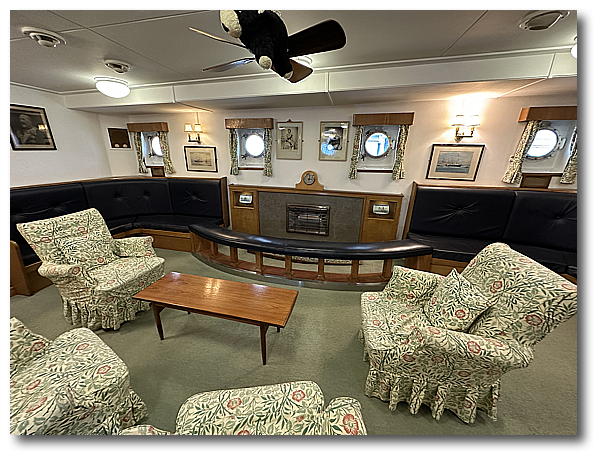
The Wardroom Anteroom was where the officers could relax when not on duty. We were told that a favourite game was to throw the wombat onto the spinning fan and try to "bat" it as was flung around the room!

The Officer's Wardroom. Dinner here was a formal affair with the officers dressed in their "Red Sea Rig" for the occasion.

One setting of the above

Part of the silverware in the Wardroom

There were three galleys on the Britannia, one for the Royal Family, one for the officers, and one for the crew. This is the china pantry.

The State Dining Room

The clocks on Britannia (this one in the State Dining Room) are all stopped at 3:01pm, the moment the Queen disembarked for the last time.

The State Dining Room displays many objects given to the Queen and The Duke of Edinburgh on their many overseas visits. This one cam from Easter Island.

This is the Queen's Sitting Room, where the Queen would work for several hours a day on the state papers brought to her in distinctive red boxes. These were flown or shipped out to the Britannia wherever she was in the world.

The Queen's desk

The Duke's Sitting Room

No rivets were used in the hull of the Britannia

Part of the engine room. The engines were steam-driven the boilers first being fired by furnace fuel until converted to oil in 1983.

The State Drawing Room

The Welmar grand piano in the State Drawing Room

I smiled when I saw the title of the music left on the piano!

This gangway was used only by members of the Royal Family.

Not everyone had their own bedroom!

The NAAFI (Navy, Army and Air Force Institute) was the on board shop. It was open to everyone and stocked basics such as toothpaste. The Royal children often visited to stock up on sweets! It now sells sweets and treats such as fudge.

The Mail Office

The Sick Bay
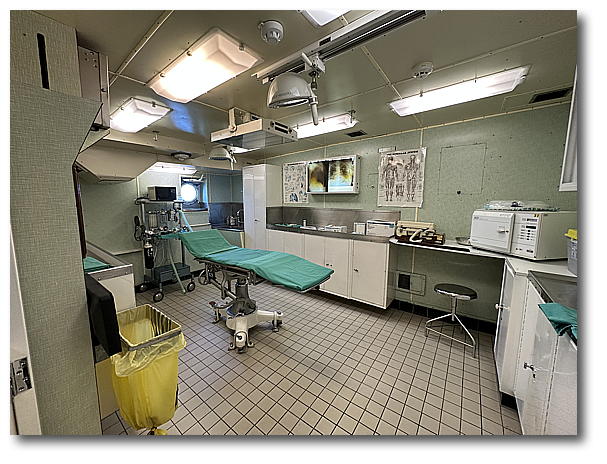
The Britannia even had its own operating theatre. In the event of a war, the Britannia was designed so that she could be converted to a hospital ship. Fortunately, this never happened.


The Laundry. Clothes belonging to the Royal Family were washed separately from everyone else's!


The Royal Barge
Next on our itinerary was a visit to Edinburgh Castle. Hundreds of people were making their way up the steep hill to the entry. We feared that it would be very crowded but were relieved to find that, because the castle is so big, it didn't feel too crowded.


Grandstands being erected for the Royal Edinburgh Military Tattoo.

There were many steps to be negotiated.

The views from the castle are extensive.


I'm not sure what this building is but it is certainly different!

This is the "One O'Clock" gun. It is fired, not surprisingly, at 1:00pm ever day excepts Sundays, Good Friday and Christmas Day. Its original purpose was to aid ships' crews to have an accurate time.


Lunch at the café

This is the Scottish War Memorial

The front of the Scottish War Memorial (the interior of which was one of the few places in the Castle where photography was not permitted).

The entry to the
Scottish War Memorial
The Royal Palace contained a number of rooms and exhibits, the "Honours of Scotland" (the Scottish Crown Jewels and the Stone of Destiny) in particular. Photography was permitted in some of them.

A portait of James VI at the age of 16...

...and another one when he was considerably older.

The Laich Hall


The Great Hall, built in 1512. When Cromwell captured the castle in 1650, he converted the room into soldiers' barracks and it remained in military use for the next 230 years. In 1886, work began to restore the room to its former glory and most of the interior dates to that time.


A reproduction of St Edward's Chair and the Stone of Destiny. An American visitor was heard to exclaim "What is that thing right there, it looks like polystyrene!" And it did too!


This is "Mons Meg". Weighing six tonnes with a bore of 48cm, it is possibly the largest gun ever fired in anger in Britain. It was used in 1489 to attack the castles of Duchal, Crookston and Dumbaton which all quickly surrendered rather than face the wrath of "Mons Meg"!

This is St Margaret's Chapel which is the oldest building in the castle having been built in 1130 by King David I as a private royal chapel dedicated to his mother, Queen Margaret, later to be St Margaret.

Inside St Margaret's Chapel

St Andrew

This is Douglas Strachan's stained glass window depicting St Margaret

A depiction of William Wallace, one of the leaders of the First War of Scottish Independence.

From the castle, we ventured down the "Royal Mile" which
runs from Edinburgh Castle to Holyrood Palace.

Along the way, there were many souvenir shops. I thought the name of this one was very witty!


Angels tell the women at the tomb that Jesus has risen.
Along the way, there were many souvenir shops. I thought the name of this one was very witty!
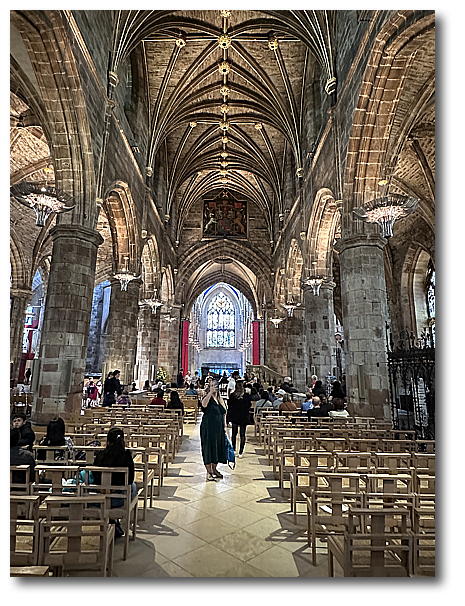
We came to St Gile's
Cathedral, which was begun in the 14th century with
extensions and alterations in the 16th, 19th, and 20th
centuries. It is now part of the Church of Scotland (ie
Presbyterian).
Angels tell the women at the tomb that Jesus has risen.

The Nativity

The Lectern


There was a series of carvings depicting the trades used to build the cathedral.

Satoshi with John Knox, who became the first Protestant minister of the cathedral in 1559.

Sts Columba, Andrew and Cuthbert

Melchizedek, Abraham and Isaac

Abel, Enoch and Noah

Scenes from the story of Joseph: Jacob gives him his coat of many colours, his brothers tell Jacob that Joseph has been killed, Joseph interprets the dreams of the baker and the butler, and pharaoh rewards Joseph for saving Egypt from seven years of famine.

Jacob is reunited with Joseph in Egypt.
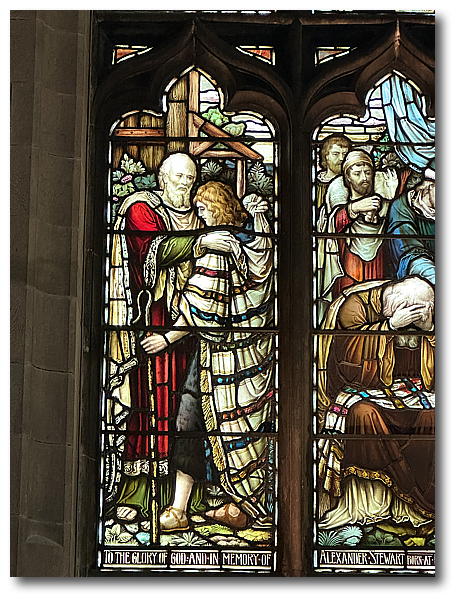
A detail of the Joseph story

Looking up!
Unfortunately, Holyrood Palace was closed
because one dignitary was in residence but we were able to peer
in through the gates.


Dinner was at a different Toby Carvery!