
"The Maid of the Forth" making her way to Hawes Pier. The bridge is the Queensferry Crossing.

A section of the Forth Rail Bridge

This is Inchgarvie Island. It was used for the foundation of one of the Forth Rail Bridge's cantilevers. It is now uninhabited and is left to the sea birds.
Inchcolm Abbey is the best preserved of all the
abbeys in Scotland. Almost all of the buildings are still
standing, including the roof, except for the abbey church, of
which there is little left.

Inchcolm Abbey


The Abbot's House

The Undercroft is under the Abbot's House There were ovens for the baking of bread here.

The thickness of the walls can be seen here

One of the ovens


There were several spiral staircases to be negotiated.


The Abbot's Study


The first church was replaced by a larger one. This was the rood screen of the first church, separating the nave from the quire.


The Guest Hall


The Refectory

It was possible to roast a whole ox in this fireplace in the kitchen!

Parts of this spiral staircase were particularly narrow with uneven steps and not lit. I was surprised that it was open to the public, but I went up it anyway!

At some time, the Bell Tower was also a dovecote. Each pair of doves had their own little spot to nest.

The view from the top of the tower back to the visitors' centre with the pier on the left.
A 360° view from the Tower

During both world wars, the island was fortified to help prevent enemy ships and submarines from using the River Forth. There are still remnants of these operations on the island.

The east screen of the second church. The site of the high altar is behind the photographer here.


A Herring Gull

Lesser black-backed gulls


The Canon's Dormitory

The Warming House


Oxcars Lighthouse first came into operation on 15th February 1886. It was originally lit using an oil burner. In 1894, it was the first manned Northern Lighthouse Board lighthouse to be converted to automatic operation.

A seal using a buoy as a lounge chair.
We were not the only vessel to sail under the Forth Rail Bridge.

This is the Queensferry Crossing bridge, built in 2017.

The underneath of the Forth Road Bridge

Another view of the Queensferry crossing

Under the Queensferry Crossing


All three bridges
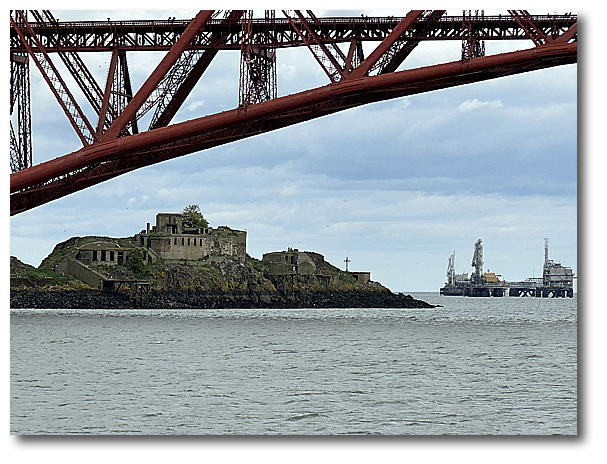
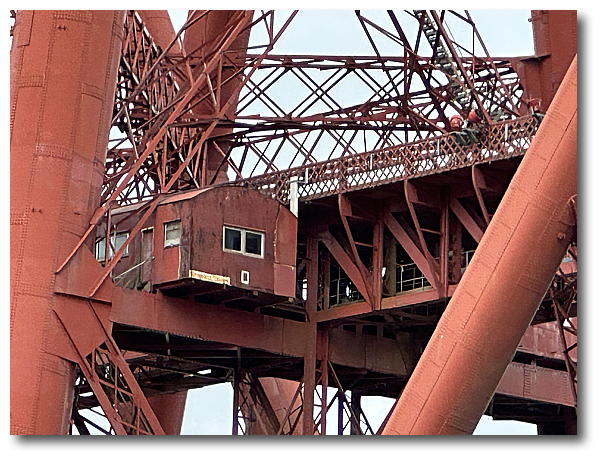
A detail of the Forth Rail Bridge
Our second stop was the Falkirk Wheel.
This is a remarkable feat of engineering and is the only one
of its kind in the world. Its purpose is to lift narrow
boats up 35 metres in order to allow them to move from one
canal to another. Originally, the Union Canal and the Forth
& Clyde Canal were linked by a series of 11 locks. With a
35-metre difference in height, it required 3,500 tonnes of
water per run and took most of a day for a narrow boat to
pass through the flight. By 1930, these locks had fallen
into disrepair and they were removed in 1933. With the
renewed interest in narrow boats in the late 1990s, the
feasibility of linking the two canals again was considered.
The Falkirk Wheel has two gondolas which can each hold up to
three narrow boats. In the photo below, one of these
gondolas is submerged at the base of the wheel ready for a
boat or boats to enter. The other is at the top of the
photo. The wheel is rotated moving the bottom gondola to the
top and vice-versa. This whole process takes about 10
minutes and can be seen in the video below. The whole thing
is very impressive indeed!


In this video, you can see the gate at the front of the gondola being lowered to allow our vessel to move forward into the canal 35 metres above where we started.


This aqueduct links the Falkirk Wheel with the Union Canal.
Following our experience at Falkirk Wheel, we
drove back to Edinburgh where we were to meet Ena and William
Mackay (friends of Jenny Roe). Mr Mackay was the principal of
Presbyterian Ladies' College in Burwood where Jenny taught for
many years. We had a very enjoyable two hours with these lovely
people chatting about mutual friends at home, Mr Mackay's time
as principal of a school in Peru and Mrs Mackay's experiences as
a teacher of English as a Second Language. We wished that we
could have spent more time with them but our itinerary did not
allow for this. Thank you for your hospitality, Ena and Willie!


